
Medical Catheters and Plastics: Definition, Design, and Dimensions
Medical catheters are thin, flexible tubes inserted into the body to serve a wide range of diagnostic and therapeutic functions. The word catheter originates from the Greek verb kathiemai, which translates to “let down,” indicating how the device is inserted into the body.
Based on the construction material, production method, and design, catheters can be customized for applications in cardiovascular, neurological, gastrointestinal, urological, and ophthalmic fields. To cite an example, in cardiovascular medicine, there are various catheter types, such as electrophysiology catheters, PTCA (percutaneous transluminal coronary angioplasty) balloon catheters, intravascular ultrasound (IVUS) catheters, guiding catheters, angiography catheters, and pulmonary artery catheters
Cardiac catheters can be classified broadly into two categories:
- Diagnostic catheters: used to evaluate the patient’s condition and detect cardiovascular disease.
- Interventional catheters: designed for therapeutic purposes, such as angioplasty, ablation, or delivery of implants like pacemakers and defibrillators.
Key Design Features of Catheters
For catheters to function effectively and safely, their design must carefully align with their intended application. Some of the most important design considerations include:
- Mechanical Properties: The strength, flexibility, burst resistance, and steerability of the catheter are determined by both the material and the structural design (inner and outer diameters, lumen geometry).
- Radio-opacity: To ensure accurate placement under X-ray imaging, catheters are often made radio-opaque either by compounding materials with contrast agents or adding radio-opaque markers.
- Surface and Friction: A smooth surface reduces friction, enabling the catheter to pass easily over guidewires and through blood vessels without damaging surrounding tissue.
- Atraumatic Tip: Specially designed soft tips minimize injury during insertion and navigation through the vasculature.
Catheter Size and Its Impact
Catheter performance is also strongly influenced by size. The French (Fr) scale is the standard measure used, where:
D(mm)=Fr3D (mm) = \frac{Fr}{3}D(mm)=3Fr
Here, the French size divided by three gives the outer diameter in millimetres. This scale was introduced by Joseph Charrière, a 19th-century Parisian surgical instrument maker.
The circumference of a catheter (C) is only slightly greater (by about 4.7%) than its French size:
C=πDC = \pi DC=πD
While a higher French size indicates a larger outer diameter, the internal volume of the catheter depends on its wall thickness and lumen geometry. Therefore, catheter sizes need to be precisely chosen to achieve a balance between flexibility, durability, and fluid flow characteristics, ensuring optimal performance for the intended medical procedure.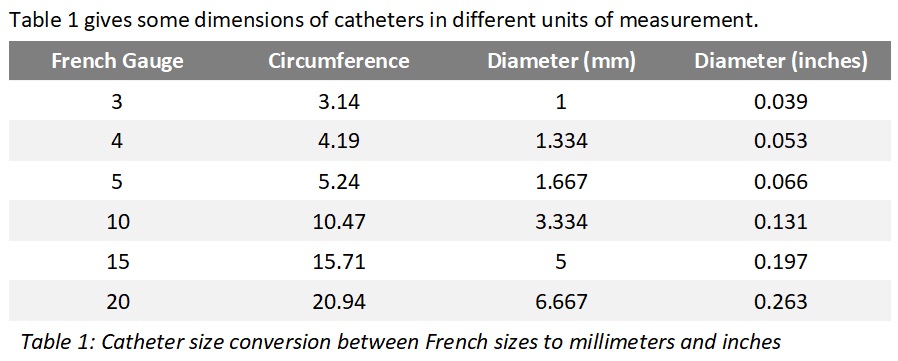
If you have any other questions or would like to suggest topics for us to write about, please feel free to contact us at info@polymerupdateacademy.com
Author
Mr. Ajay D Padsalgikar(Ph.D. - California, USA)
Trainer at Polymerupdate Academy

