
Challenges with Wood-Plastic Composites
Wood–plastic composites (WPCs) represent a remarkable innovation in the field of material science. The creation of these versatile materials is achieved by blending wood flour, thermoplastics, and additives through processes like extrusion, injection molding, or compression molding. In WPCs, the plastic acts as the continuous phase, providing toughness, while wood flour serves as the dispersed phase, offering strength and stiffness. This unique combination allows WPCs to be manufactured into solid materials with diverse shapes, sizes, and colors, akin to traditional thermoplastics.
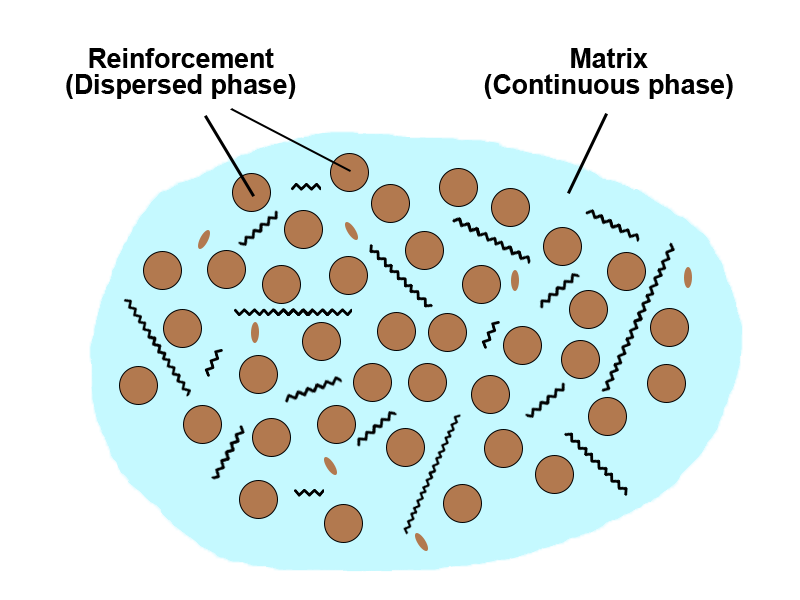
Dispersed (wood) and continues (plastic) phases in a WPC
What makes WPCs even more appealing is their ability to utilize waste materials and by-products from the wood and agricultural industries, such as sawdust, rice straw flour, and pulping sludge, as raw materials. This sustainability aspect has garnered WPCs the title of "green composites." In contrast to traditional composites, WPCs possess several advantages, including lightweight properties, cost-effectiveness, regeneration potential, biodegradability, and reprocessing capabilities. These qualities have led to the widespread application of WPCs in various industries, from decking and railing to siding, fences, windows, door frames, and even playground equipment.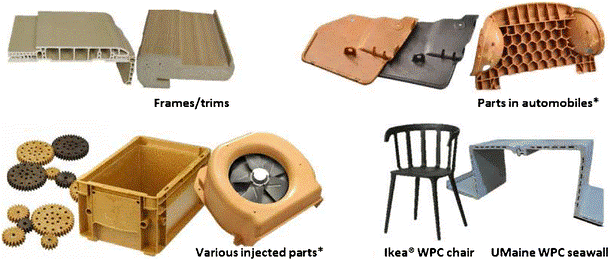
Some WPC profile applications (Picture Credits: https://link.springer.com/article/10.1007/s40725-015-0016-6/figures/2)
However, despite the many advantages offered by them, WPCs present several challenges in terms of compatibility and susceptibility to environmental factors. With this blog, let us explore the key issues surrounding WPCs and discusses innovative approaches to overcome these challenges.
• Compatibility: The Wood-Plastic Interface
One of the fundamental challenges in the production of WPCs is the inherent incompatibility between polar wood and nonpolar thermoplastics. This incompatibility significantly impacts the properties of the resulting WPCs. To address this issue, various methods have been employed, including wood flour modification and the addition of compatibilizers and coupling agents. These techniques help enhance the interface between the wood flour and plastic matrix, resulting in more robust and durable WPCs.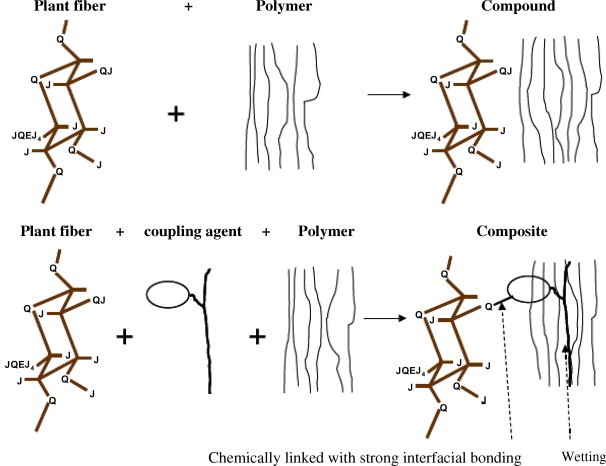
Impact of Coupling agent in a WPC (Image Credits: https://www.sciencedirect.com/science/article/abs/pii/S0960852407007560)
• Moisture Absorption and Swelling
Another challenge arises from the hydrophilic nature of wood flour, which causes moisture absorption and thickness swelling of WPCs in humid environments. When absorbed water disrupts the interfacial adhesion between the wood flour and plastic matrix, it can lead to a notable loss in material properties as seen in the graph for PP based WPC. Furthermore, moisture absorption plays a critical role in the degradation of WPCs when exposed to fungi, insects, freeze-thaw cycles, and ultraviolet light. WPCs with plastic-rich surfaces prepared by injection molding exhibit lower water absorption and superior weathering resistance. This has led to the promising approach of coating WPCs with a plastic-rich layer to reduce moisture absorption and enhance weathering resistance.
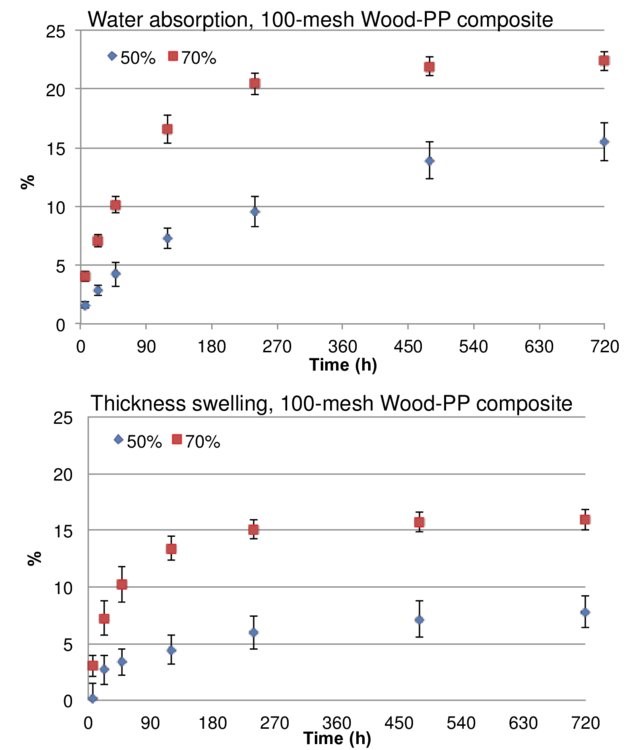
Water absorption and thickness swelling of WPCs (Picture Credits: https://jtatm.textiles.ncsu.edu/index.php/BioRes/article/view/BioRes_08_1_1222_Kartal_Wood_Bamboo_Composites_Fungal_Termite)
• Flammability
The organic nature of the main constituents in WPCs makes them inherently flammable. To mitigate this, traditional methods involve the addition of fire retardants to the bulk composites. However, the downside is that these fire retardants can reduce the mechanical properties of WPCs and increase production costs. Recognizing that environmental factors primarily affect the surface of WPCs, it becomes evident that surface modification is more crucial than altering the bulk materials. By incorporating additives into the surface layer, the required number of additives is reduced, making it a cost-effective and efficient way to improve the durability of WPCs.
Coextrusion processes are a widely used and mature method for producing coextruded WPCs (Co-WPCs) with a clear cap layer. The core–shell structure provided by Co-WPCs offers a versatile platform for designing composites with various performance characteristics to adapt to different service conditions. The multilayer structure of Co-WPCs presents complex properties that require thorough analysis to create composites with predictable and desirable performances. Co-WPCs maintain the same fundamental compositions as traditional WPCs. In these composites, commonly used thermoplastics like high-density polyethylene (HDPE), polypropylene (PP), and polyvinyl chloride serve as the matrix materials, while wood flour plays a crucial role as the primary reinforcing filler. To enhance the compatibility between the plastic and wood flour and to optimize the performance of the composite production process, certain additives are incorporated into Co-WPCs. These additives include maleic anhydride grafted polyethylene/polypropylene and lubricants. Notably, the presence of the shell layer in Co-WPCs exerts a constraining influence, enabling the use of lower-grade feedstock such as recycled plastics and agricultural waste materials in the core layer. This practice helps reduce production costs while maintaining the desired composite properties. The proportion of plastic in the core layer of Co-WPCs typically falls within the range of 30–70 wt%, a range consistent with that of common WPCs. As the content of wood flour in WPCs increases, it results in higher viscosity and reduced mobility of the composite melts during the extrusion process. To counteract this, the plastic proportion in the shell layer is typically higher than 70 wt%, which effectively enhances the encapsulation of the core layer, ensuring the overall integrity and performance of Co-WPCs.
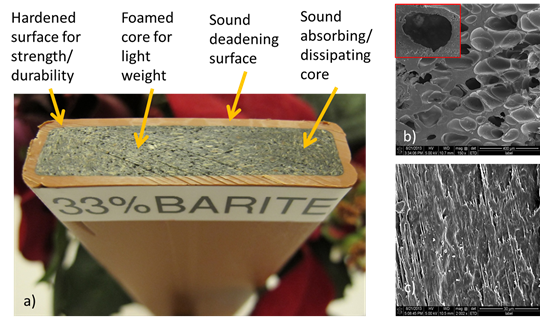
Co-extruded WPC Profile for noise insulation purposes (Picture Credits: https://jtatm.textiles.ncsu.edu/index.php/BioRes/article/view/BioRes_09_1_Zhu_Review_Sound_Insulation_Properties)
All in all, WPCs are innovative materials that combine the strength and stiffness of wood flour with the toughness of thermoplastics. Despite facing compatibility and environmental challenges, various strategies such as wood flour modification, surface coating, and coextrusion have been developed to overcome these hurdles. WPCs offer a sustainable and versatile solution for a range of applications, from outdoor decking to interior furnishings, providing an environmentally friendly alternative to traditional materials. As research in this field continues to evolve, we can expect even more remarkable innovations that push the boundaries of what is possible with WPCs.
If you have any other questions or would like to suggest topics for us to write about, please feel free to contact us at prashant.gupta@polymerupdateacademy.com
Author
Dr. Prashant Gupta
Faculty, Polymerupdate Academy

