
Polymers for Developing Composites in Thermal Insulation Applications
As winter approaches, the importance of efficient thermal insulation becomes increasingly evident. Thermal insulation materials play a crucial role in maintaining comfortable indoor temperatures and reducing energy consumption. Over the last few years, developing economies have experienced significant challenges in keeping their populations warm when harsh winters set in. The desperation has been discernible to the point that some countries had to turn back the clock in terms of resources to be used for generation of electricity. The material used in construction of structures has a pivotal role to play in terms of optimizing energy efficiency to ensure warm temperatures. Among the wide array of materials used in thermal insulation, polymers have gained significant attention for their versatility and low thermal conductivity. In this blog, we will explore various polymers commonly used in developing composites as a matrix material for thermal insulation applications and the unique characteristics that make them suitable for this purpose.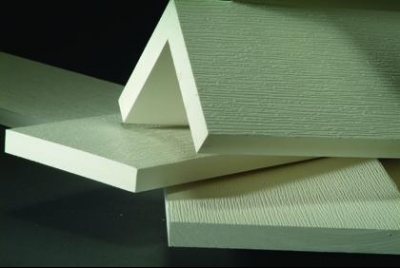
Polymer Composites in Construction for thermal insulative applications (Pic Credits: https://www.greenbuildingsolutions.org/blog/composites-high-performance-building-solutions/)
• Polyurethanes (PUs): Versatile and Efficient
Polyurethanes, often referred to as PUs, are undoubtedly one of the most commonly used polymeric matrices for thermal insulation applications. What sets PUs apart is their remarkable versatility in terms of chemical structure. They are derived from two main constituents: polyisocyanates and polyols. The chemical structure of these constituents can vary, resulting in a wide range of potential molecular designs for PUs. This versatility allows PUs to be tailored to be either rigid or flexible.
Rigid PUs, sometimes called PURs, are characterized by a highly cross-linked structure, which includes short alkylic segments. This structural composition imparts excellent mechanical properties such as tensile strength and shear resistance to the resulting polymer. Moreover, PUs inherently possess low thermal conductivity at room temperature, making them an ideal choice for thermal insulation. However, their synthesis involves the use of isocyanates, which can be irritants for the respiratory system and eyes.
• Polystyrene (PS): Inexpensive and Mechanically Robust
Polystyrene (PS) is another polymer frequently employed in thermal insulation composites. This thermoplastic material is cost-effective, mechanically robust, and easy to extrude and mold. With an inherently low thermal conductivity of approximately 0.2 W/mK, PS serves as an excellent matrix for polymer-based nano-composites for thermal insulation. However, its high rigidity (Young's modulus of about 3 GPa) may limit its use in applications requiring flexibility.
• Poly(methylmethacrylate) (PMMA): Lightweight and Transparent
Poly(methylmethacrylate), or PMMA, is a lightweight, low-cost, transparent, and easily processable thermoplastic polymer. Similar to PUs and PS, PMMA exhibits low thermal conductivity, usually less than 0.2 W/mK. These properties make PMMA an attractive choice for thermal insulation materials, particularly in applications where transparency or optical clarity is desired.
• Polypropylene (PP): A High-Strength Option
Polypropylene (PP), especially in its foamed version, is actively being explored for thermal insulation applications. While pristine PP has relatively high thermal conductivity (about 0.27-0.30 W/mK), it compensates with remarkable mechanical strength and thermal stability. With a Young's modulus of about 1300-1800 MPa and good resistance to high temperatures, PP is widely used in packaging, automotive, and various industrial applications.
• Polyethylene (PE): Versatility in Molecular Structure
Polyethylene (PE) is another polymer used in thermally insulating composites. It offers good mechanical properties, although slightly less pronounced than PP. PE can be synthesized in various versions, including Low-Density Polyethylene (LDPE), High-Density Polyethylene (HDPE), and Linear Low-Density Polyethylene (LLDPE). These variations differ in molecular weight and lateral branching of the main chain, leading to different densities and mechanical and thermal properties. HDPE, with a thermal conductivity of around 0.4-0.5 W/mK, is known for its mechanical robustness.
• Epoxies: Cross-linked Polymers with Unique Properties
Epoxies are cross-linked polymers, also known as thermosets, derived from various monomers with diverse chemical structures. Their mechanical properties can be finely tuned by adjusting the chemistry of the cross-linked monomers and the degree of crosslinking. Epoxies are often used as matrices for syntactic foams and, in some cases, for all-solid composites in thermal insulation applications.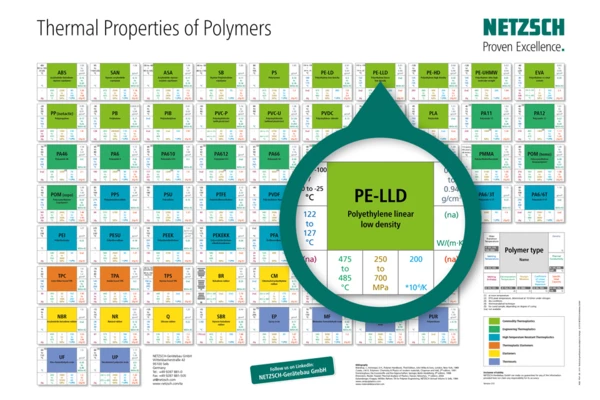
Thermal Properties of polymers (Pic Credits and Full Size image at https://analyzing-testing.netzsch.com/en/media/poster )
In addition to the polymers mentioned above, numerous other types of polymeric matrices have been explored and continue to be researched for thermal insulation applications. These include various nanocomposites, blends, and specialty polymers designed to meet specific thermal insulation needs. In the thermal insulation sector, the selection of the right polymer matrix is pivotal. Polymers such as polyurethanes, polystyrene, poly(methylmethacrylate), polypropylene, polyethylene, and epoxies offer a diverse range of options to address specific thermal insulation requirements. Their low thermal conductivity, mechanical properties, and versatility make them well-suited for a variety of applications. As research continues and technology evolves, the field of thermal insulation is witnessing the development of even more advanced polymer-based composites for example, aromatic thermosetting polyesters, with Tg more than 250 ºC. superinsulating nano-foams with tailored properties and high thermal stability, achieving ultra-low thermal conductivities, innovative concepts like phase change nanoparticles offer temporary heat control, high-performing syntactic polymer foams utilizing hollow nanometric spheres for exceptional insulation, etc., providing innovative solutions for improved energy efficiency and comfort during the cold winters.
If you have any other questions or would like to suggest topics for us to write about, please feel free to contact us at prashant.gupta@polymerupdateacademy.com
Author
Dr. Prashant Gupta
Faculty, Polymerupdate Academy

