
Materials and Techniques for the preparation of Polymer Nanofibers
Polymer nanofibers are ultra-thin fibers with diameters typically in the nanometer range (1-100 nanometers). These fibers possess unique properties due to their high aspect ratio (length-to-diameter ratio), large surface area, and quantum effects at the nanoscale. The versatility of Polymer nanofibers can be attributed to their ability to be produced from a wide range of polymers, each offering a distinct set of attributes and applications. Through a meticulous control of parameters such as diameter, length, orientation, and surface topology, an extensive array of polymers can be electrospun into ultrafine fibers at the nanoscale range. The morphology of these fibers is significantly influenced by a multitude of factors associated with both the solution and the processing. These encompass attributes like viscosity, polymer concentration, molecular weight, applied electrical field strength, conductivity, and the distance between the tip and collector.
Polymer nanofibers can be meticulously crafted using an assortment of innovative methods. Electrospinning, for instance, entails the creation of nanofibers through the application of an electric field to a polymer solution, yielding ultrafine fibers prized for applications in filtration and tissue engineering. On the other hand, Spinneret-based Tunable Engineered Parameters (STEP) and drawing techniques leverage mechanical forces to elongate and refine polymers, achieving dimensions at the nanoscale. The art of template synthesis employs porous templates to gently guide the growth of polymers into intricate nanofiber structures. In contrast, phase separation/inversion strategically harnesses the division of polymer-rich and solvent-rich phases, giving rise to intricate nanofibrous networks. The principle of self-assembly orchestrates polymer molecules to elegantly align into nanofibers via controlled interactions, unlocking transformative potential in the domain of nanocomposites. Solution blowing (air jet spinning) employs high-velocity air currents to deftly stretch and solidify polymer solutions into the delicate threads of nanofibers. Forcespinning (centrifugal spinning), elongates polymers into nanofibers with an eye toward scalability. Lastly, interfacial polymerization prepares nanofibers at the dynamic boundary of liquid-liquid interfaces by triggering polymerization.
Among these techniques, electrospinning stands as the quintessential technique, revered for its practicality, cost-efficiency, and the capacity to seamlessly yield uninterrupted fibers from a diverse spectrum of polymers. Its suitability for large-scale manufacturing further solidifies its status as the primary technique of choice.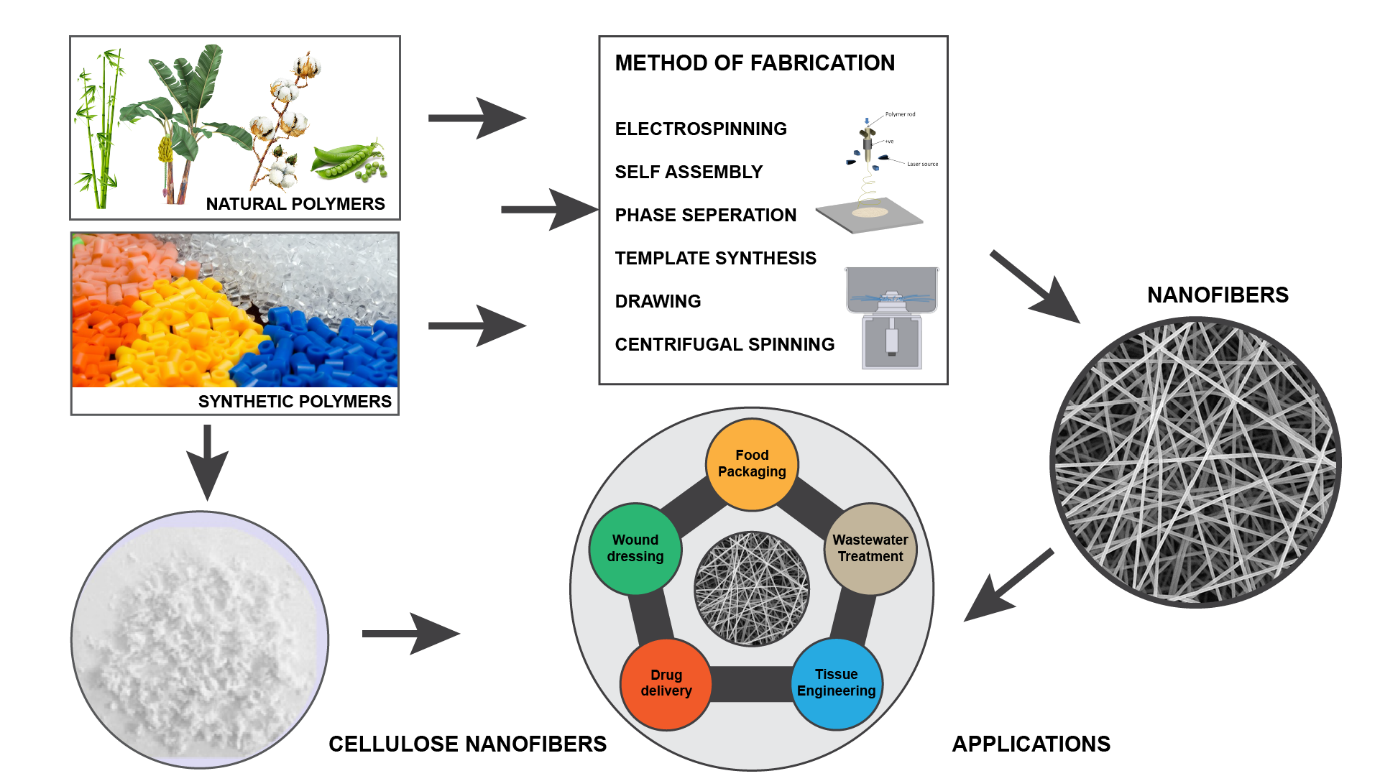
Various methodologies for synthesis of polymeric nanofibers (cellulose as a case) https://www.sciencedirect.com/science/article/pii/S2666893922000779
The natural polymeric materials that can be processed into nanofibers include proteins (e.g., collagen), nucleic acids (e.g., DNA), polysaccharides (e.g., hyaluronic acid), and lipids (e.g., lecithin). Their synthetic counterparts such as polyglycolide, polylactide, and poly (έ-caprolactone) have been fabricated and employed for use in tissue engineering applications. Furthermore, biodegradable polymers, including but not limited to poly caprolactone, poly (lactic acid), poly (glycolic acid), polyurethane, copolymer poly (lactic-co-glycolide), and the copolymer of poly (L-lactide-co-ε-caprolactone), processed in nanofibrous form have found diverse applications in bone tissue engineering, heart grafts, wound dressings, and the development of substitutes for cardiovascular vessels.
Polymer nanofibers have fuelled revolutionary transformations across different critical sectors. In the realm of biomedical engineering, they have become instrumental in driving innovations like tissue engineering, wound management, drug delivery, and regenerative medicine. The extensive surface area of these nanofibers facilitates efficient drug release and fosters intricate interactions with cellular structures, enhancing therapeutic outcomes. Venturing into electronics and sensors, their extraordinary mechanical attributes and impressive aspect ratio have paved the way for flexible electronics, wearable devices, and adaptive smart textiles that seamlessly integrate technology into everyday life.
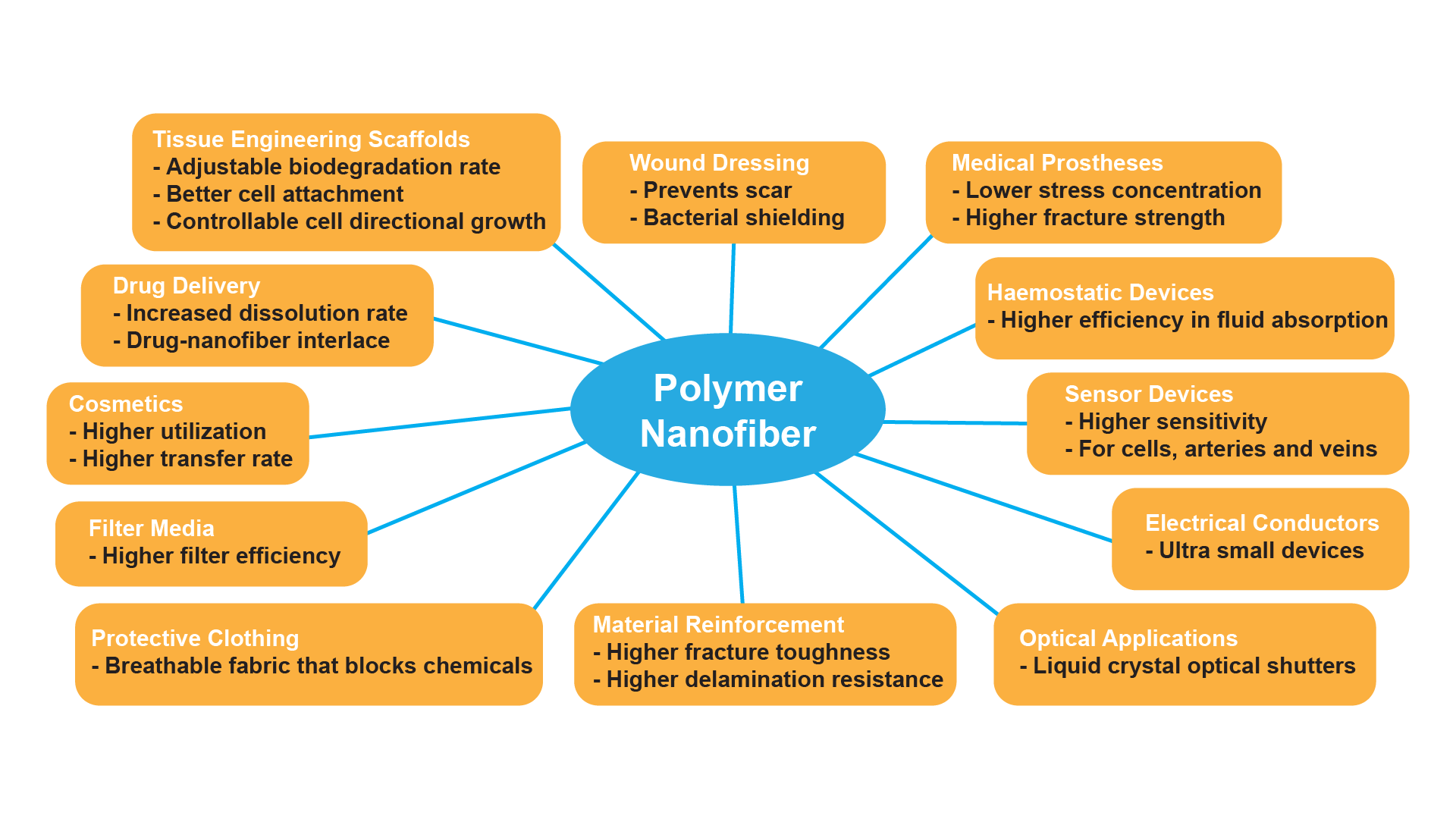
Salient features in focus for various applications of polymeric nanofibres
(Reference: https://www.azonano.com/article.aspx?ArticleID=1280)
Their impact extends to environmental applications as well, where polymer nanofibers exhibit remarkable potential for safeguarding our ecosystems. By serving as efficient filters for air and water purification, they capture fine particulates, bacteria, and other pollutants, thereby ameliorating both indoor and outdoor air quality and contributing to the preservation of natural resources. Furthermore, in the pursuit of sustainable energy solutions, these nanofibers are being actively explored as promising electrode materials in energy storage devices such as batteries and supercapacitors. Their generous surface area and swift ion diffusion characteristics hold the key to unlocking enhanced energy storage capabilities, thus playing a pivotal role in the ongoing evolution of clean and efficient energy technologies. They can also be used in packaging to improve barrier properties, extending the shelf life of perishable goods. They are also employed as coatings for various substrates, imparting functionalities like water repellency and antimicrobial properties.
While polymeric nanofibers offer a multitude of possibilities, some challenges remain. Scaling up the production process to meet industrial demands while maintaining fiber uniformity and quality is a persistent hurdle. Along with that, though electrospinning is the best process of the lot, limitations inclusive of such as high voltage requirements, low production rate, high dependency on polymer properties, and safety problems have led to development of other non-electrospinning techniques. While the production capacity of these alternative methods might be comparatively lower, their intricate 3D architectures undoubtedly emerge as compelling contenders for a range of groundbreaking biomedical applications. These encompass the realms of tissue engineering, the reinforcement of materials, the development of intelligent textiles, the creation of actuators, and the fabrication of advanced sensors. Additionally, ensuring the safety and biocompatibility of nanofiber-based products is crucial for their successful integration in various applications. Looking ahead, nanofiber research will focus on novel materials, functionalization techniques, and innovative manufacturing processes. Collaborations between academia and industry will drive advancements, resulting in new products and technologies that shape the future especially in biomedical applications, as there is a pressing need for extensive research aimed at delving into critical aspects such as the mechanical attributes, degradation rates, and biocompatibility of polymer nanofibers. These studies will prove to be pivotal in paving the way for the safe and effective integration of nanofibers into clinical contexts.
If you have any other questions or would like to suggest topics for us to write about, please feel free to contact us at prashant.gupta@polymerupdateacademy.com
Author
Dr. Prashant Gupta
Faculty, Polymerupdate Academy

