
Polymer Nanocomposites: The Path to Advanced Materials
Polymer nanocomposites have witnessed remarkable advancements, profoundly impacting diverse industries like automotive, aerospace, electronics, medical devices, and more. The incorporation of nanoparticles into polymers offers various advantages such as superior mechanical properties, weight reduction, enhanced fuel efficiency, and improved thermal stability in the automotive and aerospace sectors. In electronics and electrical industries, nanocomposites provide lightweight, flexible, and conductive coatings, while in medical fields, they facilitate the provision of biocompatible materials for implants, drug delivery, and tissue engineering. They also contribute to sustainable packaging with extended shelf life in the food industry and drive advancements in energy technologies, such as solar cells and energy storage devices. As research progresses, the future holds promising innovations, pushing the boundaries of these materials for a greener, more advanced world.
Polymer nanocomposites are hybrid materials that combine polymers with nanoparticles, typically having at least one dimension in the nanometer range (1-100 nanometers). There are various kinds of nanostructured materials, including:
1. Carbon-based nanomaterials: These include carbon nanofibers, graphene, fullerenes (C60), carbon nanotubes, and carbon black and are made of carbon and can be found as spheres, nanofibers, or ellipsoids;
2. Organic/inorganic-based nanomaterials: those containing organic material are referred to as organic-based NMs, while those without organic material are referred to as inorganic-based NMs. Non-covalent (weak) interactions are primarily used to form organic NMs into the necessary structures, such as liposomes, polymers, micelles, and dendrimers.
3. Composite-based nanomaterials: These are multiphase NPs and NSMs with a single phase on the nanoscale dimension, which can be created through various means including the combining of NPs with other NPs, NPs with larger or more complex NPs, NPs with metal-organic frameworks, or NPs with bulk-type materials. Metal-based, organic-based, or combinations of these materials are used to create composites.
When incorporated into polymers, these nanoparticles impart exceptional properties that go beyond the limitations of conventional materials.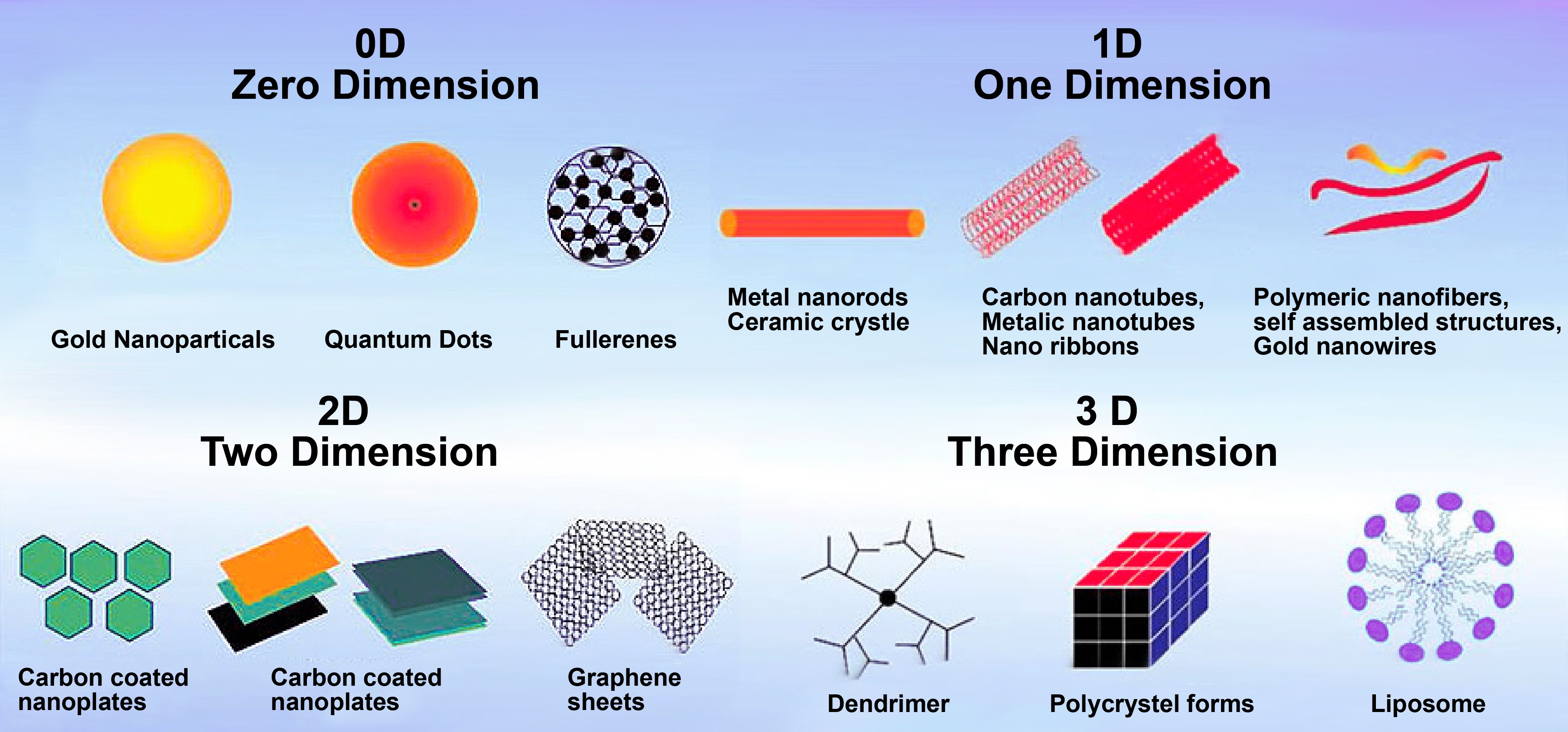
Nanomaterial classification of the based-on shape and size of nanoparticle
Creating well-dispersed and uniform nanocomposites requires precise engineering. Some common techniques include:
- In-situ Polymerization: The nanoparticles are synthesized and polymerized within the same reaction, resulting in the formation of nanocomposites with excellent dispersion of nanoparticles throughout the polymer matrix. The process typically involves adding monomers, nanoparticles, and polymerization initiators to a reaction vessel. The reaction is then initiated, and the monomers undergo polymerization, simultaneously incorporating the nanoparticles into the growing polymer chains. This intimate mixing at the molecular level enhances the compatibility between the nanoparticles and the polymer, leading to improved mechanical, thermal, and barrier properties of the resulting nanocomposite.
- Melt Compounding: Melt compounding is a widely used technique for preparing polymer nanocomposites. In this process, nanoparticles and polymer resins are mixed together using extruders, mixers, or kneaders at elevated temperatures. The heat melts the polymer, allowing for efficient dispersion of nanoparticles within the molten polymer matrix. Once mixed, the nanocomposite is solidified and pelletized for further processing. The success of melt compounding lies in achieving uniform dispersion and avoiding agglomeration of nanoparticles, which can negatively impact the final properties of the nanocomposite.
- Solution Casting: In solution casting, the polymer is dissolved in a suitable solvent to form a solution. Nanoparticles are then dispersed into the polymer solution, ensuring uniform mixing. The homogeneous solution is subsequently cast onto a substrate, and the solvent is evaporated to leave behind a solid nanocomposite film. The advantage of this technique is that it allows for precise control over the nanoparticle dispersion, resulting in nanocomposites with uniform structures and properties. It is particularly useful for applications where thin films or coatings are required.
- Electrospinning: Electrospinning is used to produce polymer nanofibers with enhanced properties. In this process, a polymer solution containing nanoparticles is loaded into a syringe and exposed to a high voltage electric field. As the solution is ejected from the syringe, the electric field induces a charged jet of polymer solution to stretch and form nanofibers. The fibers are collected on a grounded collector to create non-woven nanofiber mats. The incorporation of nanoparticles during the electrospinning process results in nanocomposite nanofibers with improved mechanical strength, surface area, and other desirable attributes. Electrospun nanocomposites find applications in filtration, tissue engineering, and sensors.
One of the key advantages of polymer nanocomposites is their remarkable improvement in mechanical properties. The dispersion of nanoparticles in the polymer matrix enhances its strength, stiffness, and toughness, making them superior to traditional polymer materials. For instance, the addition of only a miniscule percentage of graphene can significantly increase the tensile strength of the polymer. It also results in enhanced barrier properties, making the materials more resistant to gas permeation and moisture. This feature finds practical applications in food packaging, where it extends shelf life and prevents spoilage. Additionally, certain nanoparticles exhibit inherent flame-retardant properties, providing an extra layer of safety in critical applications. Polymer nanocomposites often exhibit improved thermal stability, enabling them to withstand higher temperatures without significant degradation. In electrical and electronic applications, the incorporation of conductive nanoparticles facilitates the dissipation of heat, preventing overheating issues. In today’s environmentally conscious world, the demand for sustainable and lightweight materials is at an all-time high and these materials offer an excellent solution, as they can reduce the overall weight of products, resulting in improved fuel efficiency in transportation and reduced carbon footprint.
On one hand, these nanocomposites have shown tremendous potential, however, on the other, several challenges remain. Achieving a uniform dispersion of nanoparticles and preventing their agglomeration is critical for optimizing material properties. Additionally, issues related to scalability, cost, and potential toxicity of certain nanoparticles need to be addressed. In the future, researchers will focus on multifunctional nanocomposites, which can combine mechanical, electrical, thermal, and barrier properties in a single material. Furthermore, sustainable and bio-based nanoparticles will play a pivotal role in the development of eco-friendly nanocomposites. It is evident that polymer nanocomposites are poised to revolutionize the polymer industry. The fusion of polymer engineering with nanotechnology opens vast opportunities for innovation and progress.
If you have any other questions or would like to suggest topics for us to write about, please feel free to contact us at prashant.gupta@polymerupdateacademy.com
Author
Dr. Prashant Gupta
Faculty, Polymerupdate Academy

